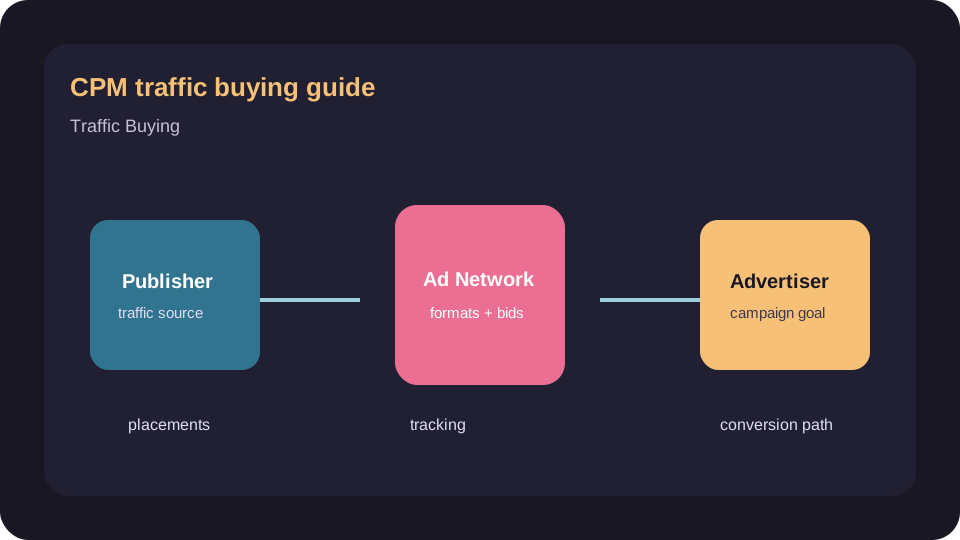
What buying on CPM means
Cost-per-mille buying charges you per thousand impressions, regardless of clicks. You take on the risk that your creative and targeting earn attention, and in return you get direct control over volume and often a lower effective cost per click when the creative performs. CPM rewards buyers who already know their funnel; it punishes weak creatives by spending steadily with little to show.
When CPM beats CPC
If your creative earns clicks efficiently, buying impressions can undercut the effective price of a click on a CPC deal, because you are not paying the premium the network builds into click pricing. High-volume formats such as popunder and in-page push are frequently bought on impression models for exactly this reason. The decision turns on one number: your effective cost per click and per conversion under each model.
| Check before buying CPM | Why |
|---|---|
| Proven creative | CPM spends whether or not it earns clicks |
| Tight targeting | Wasted impressions are wasted budget |
| Frequency cap | Prevents overpaying to reach the same users |
| Conversion tracking | Turns impressions into a real cost per result |
Controlling CPM risk
Because you pay for impressions, targeting and frequency caps are your main defences. Narrow GEO and device, cap how often one user is served, and cut placements that deliver impressions but no engagement. Without these controls, a CPM buy quietly funds views that never had a chance to convert.
Comparing the two models honestly
Run a controlled test, convert your CPM spend into an effective cost per click and per conversion, and compare that against a CPC test of the same creative. Let the model with the lower cost per real conversion win for that specific setup, rather than assuming one is always cheaper.
Ready to compare options?
Open the tracked provider page after matching the offer to CPM traffic buying requirements.