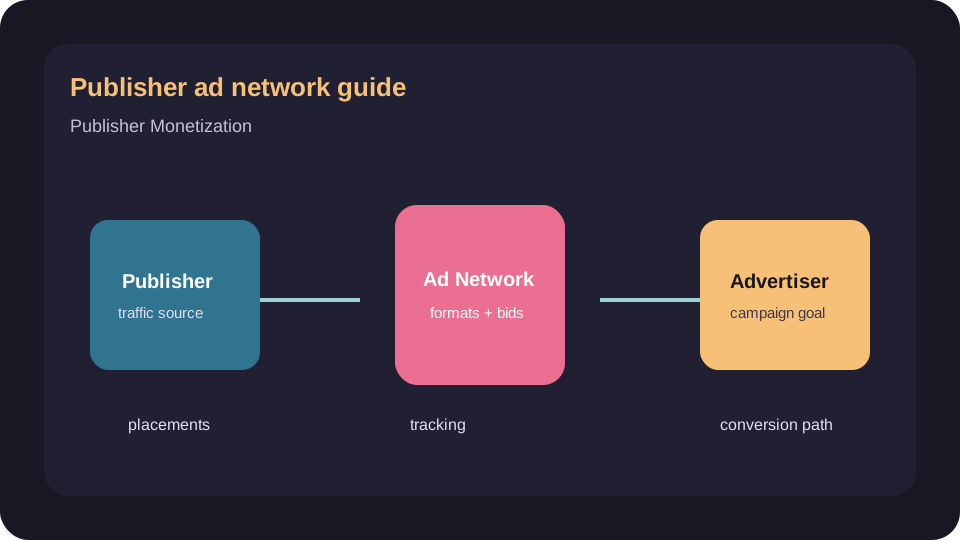
What a publisher ad network does for you
A publisher ad network gives site owners a single place to sell their inventory to many advertisers at once. Instead of finding buyers yourself, you connect your placements to the network, which fills them with paying ads and handles targeting, delivery and payment. The value is access to demand you could not reach alone, especially for formats and verticals mainstream programmes avoid.
Choosing a network that fits your site
| Factor | What to look for |
|---|---|
| Format support | Formats that fit your audience tolerance |
| Fill and GEO | Strong demand in your visitors regions |
| Effective revenue | Real earnings per thousand visitors, not headline CPM |
| Payment terms | Schedule, threshold and reliability |
| Controls | Frequency caps and category or advertiser blocks |
Match formats to your audience
The right network for a loyal editorial site is not the right one for a high-volume download portal. Content sites usually favour native and controlled display; transactional, high-traffic sites can absorb popunder and push. Pick a network whose format strengths match how much interruption your visitors will tolerate, because format fit protects the audience that generates the revenue.
Run more than the CPM
Judge a publisher network on effective revenue per thousand visitors, payment reliability and the control it gives you over what appears on your pages. A network that pays well but fills your site with low-quality creatives, or delays payment, is a poor partner regardless of its rate card.
Combine and monitor
Many publishers run more than one network to improve fill and compare performance, using controls to prevent conflicts and overexposure. Whatever you choose, watch revenue against engagement and return visits, and be willing to switch when a network stops earning its place on your inventory.
What is a publisher ad network?
A publisher ad network is a platform that buys ad space from website or app owners and resells it to advertisers. The publisher adds the network's code, the network fills ad slots with paid ads, and the publisher receives a share of the revenue. From the advertiser's side the same company is simply “an ad network”; the term publisher network describes it from the site owner's point of view.
| Type | Typical formats | Best for |
|---|---|---|
| Display / premium networks | Banners, sticky ads, video | Content sites with strong tier-1 traffic |
| Native / content-recommendation | Recommendation widgets, in-feed ads | News, blogs and magazines |
| Performance networks | Popunder, push, in-page push, direct link | High-volume or non-mainstream traffic |
| Video networks | Outstream and instream video | Sites with long sessions or own video |
Advertiser–publisher networks: how both sides connect
Most networks are two-sided: an advertiser panel for buying traffic and a publisher panel for selling it. Matching happens through an auction or fixed price per GEO and format. As a publisher you benefit from more advertiser demand; as an advertiser you benefit from more publisher supply. That is why the same network can be strong in one GEO and weak in another — demand and supply are local.
Publisher monetization strategy in three layers
- Primary network for your main placements, chosen by page RPM on your own traffic.
- Backfill — a second network or format that fills requests the primary leaves empty.
- Direct revenue — affiliate links, sponsorships or direct ad sales on your best pages.
Review the mix monthly. Compare against the high CPM guide and keep an eye on user metrics so revenue does not come at the cost of returning visitors.
Ready to compare options?
Open the tracked provider page after matching the offer to publisher ad network requirements.