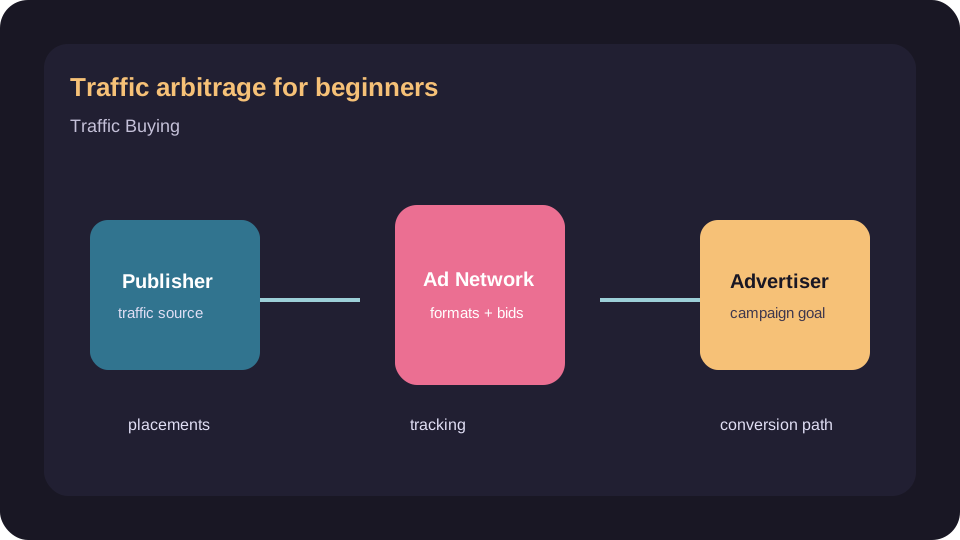
What traffic arbitrage is
Traffic arbitrage means buying visits from one source and earning more from them elsewhere, whether through an affiliate offer, your own monetised pages or an ad network on the destination. The profit is the gap between what a visit costs and what it returns. It sounds simple, but the gap is thin and easily erased by weak tracking, poor targeting or an offer that does not fit the traffic.
The arbitrage equation
Every campaign reduces to one comparison: revenue per visit versus cost per visit. If a click costs a certain amount and returns more on average, the campaign scales; if not, it leaks. Beginners lose money most often by celebrating clicks or impressions instead of watching this single ratio, and by scaling before it is reliably positive.
| Lever | Effect on the gap |
|---|---|
| Cheaper, matched traffic | Lowers cost per visit |
| Better offer or monetisation | Raises revenue per visit |
| Tighter targeting | Removes visits that never convert |
| Stronger landing page | Converts more of what you paid for |
A safe way to start
Pick one traffic source, one offer and one GEO. Set a small budget you can lose, install tracking with postbacks before the first click, and run until you have enough data to judge revenue per visit honestly. Cut what loses, keep what works, and only then think about scale. The discipline, not a secret source, is what makes arbitrage work.
Where beginners go wrong
The common mistakes are scaling on too little data, ignoring source-level reporting, chasing volume over margin and picking offers that do not match the traffic intent. Arbitrage is a numbers game played patiently; treat the first budget as tuition and protect the thin margin with tracking and stop rules.
Ready to compare options?
Open the tracked provider page after matching the offer to traffic arbitrage for beginners requirements.